
Showing posts with label garden. Show all posts
Showing posts with label garden. Show all posts
Tuesday, January 17, 2012

Tuesday, November 15, 2011
Outfox Farm on TV

Click this link to see the article and video:
Farm2Work connects farms to Arkansas workers
We wanted to get across how wonderful local agriculture was and how its is great that customers could know their farmers and where their food comes from. The internet allows urban homesteaders like us to participate with the public in the local food revolution. Hold the phone, now Channel 4 is calling...Saturday, August 27, 2011
How to get local produce from local farmers
We try to buy local, because we like to buy directly from the farmer. We can ask questions. We can determine for ourselves what food is good and good for us. We can avoid the labeling and mislabeling, the processing, the petroleum and the petrochemical industries.
Saturday mornings seem to be the best time for farmers and consumers to get together. That routine necessitates a certain regularity and consternation of purpose. Here is my morning in a nutshell.
I get up at 6am to water my garden. My front yard is the most local of all. I try to stay on my urban homestead whenever possible. That means I exercise my hobby by keeping autumn seeds moist for germination, looking for bugs to pull off the plants and generally being the farmer. This is a busy morning, so I keep my ablutions short. I nibble on a few leaves and pull some weeds which go back to the pregnant doe in the rabbit warren. I am off to work at my construction sites. I have clients to meet for Saturday morning coffee and review. I meet a carpenter at 7am and another at 8am. Back again for breakfast with the family. I pack the bags and the ice chest. Then the fun begins.
I load up Izzy in the car seat and we head out to find some farmers. First, I go the ASN market pickup downtown in Little Rock. They only have local produce from local farms that provide all their growing philosophies and are visited by market organizers and consumers alike. We did our ordering online earlier in the week at their market website. My wife had ordered cantaloupe and herbs. We have the hardest time getting a variety of fresh fruit in Arkansas. At the market, our order awaits. The helpful volunteers help you find your orders that the farmers have prepared for us. On another table I see the bags of produce from my garden that I had dropped off yesterday for other people who had sent me their requests. This is the best system for a farmer's market that exists. The people order online to get exactly what they want instead of a random box or basket. The farmers only have to harvest and deliver exactly what was ordered. Money is exchanged at the drop location and everyone is happy. If not, then the volunteers are there to help, and there are plenty of the farmers there volunteering to answer your questions directly. Everyone has a smile on their face.
Next, I head over the river to North Little Rock to the Argenta Farmers' Market. I am there to meet my main CSA farmer at her booth, Falling Sky Farm. In addition to providing us with chicken, pork and beef for the year, she provides us all our eggs, pastured and organic, every two weeks. It seems we are her largest consumer of eggs besides a bakery who gets slightly more eggs the other Saturday every two weeks. That's a frightening amount of eggs, but the lovely does a lot of cooking and grain-free baking which require a lot of eggs.
I was so happy to pick up the eggs at the market today instead of her husband delivering them to the house, because I saw my favorite bee keeper, K Bee Honey. He has been running low on inventory recently. On his booth table he had, amongst other smaller bottles, a GALLON of honey! A lot of people were joking about the size, but I snatched it up. Finally I said. Honey is the only sugar that we use, so we go through it fast. It is best to get local honey to help with your allergies of local flowers.
Loaded up at the public market, I went to a drop off location for a local farmer to get produce directly. I've been to this farmer's place and looked at his land. I found this farmer from a remote area of Arkansas, through socializing in a food buying club. We do various clubs and loose groups such as the customers of Azure Standard, who send a truck to our state every month and has a traditional catalog approach to ordering bulk food. The food in that group is not local, but sometimes certain food is just not available local, but local people can get together to share the shipping costs. We buy feed bag size portions of organic grains this way for our rabbits. Other products include truly raw nuts, coconuts and pure olive oil. On the way back home, I pass through Hillcrest's newest farmers market, doing well and staying busy. I see some of the same vendors at both markets, like Kelly's North Pulaski Farm, an organic greenhoused farm. So many good farmers, so little time. I will see Kelly later, or read about his farm on his blog or FB group. The Internet does make staying in touch with your food a lot easier.
Have a great weekend!
 | ||||||
| When we can't stay on our own side of the gate... |
I get up at 6am to water my garden. My front yard is the most local of all. I try to stay on my urban homestead whenever possible. That means I exercise my hobby by keeping autumn seeds moist for germination, looking for bugs to pull off the plants and generally being the farmer. This is a busy morning, so I keep my ablutions short. I nibble on a few leaves and pull some weeds which go back to the pregnant doe in the rabbit warren. I am off to work at my construction sites. I have clients to meet for Saturday morning coffee and review. I meet a carpenter at 7am and another at 8am. Back again for breakfast with the family. I pack the bags and the ice chest. Then the fun begins.
I load up Izzy in the car seat and we head out to find some farmers. First, I go the ASN market pickup downtown in Little Rock. They only have local produce from local farms that provide all their growing philosophies and are visited by market organizers and consumers alike. We did our ordering online earlier in the week at their market website. My wife had ordered cantaloupe and herbs. We have the hardest time getting a variety of fresh fruit in Arkansas. At the market, our order awaits. The helpful volunteers help you find your orders that the farmers have prepared for us. On another table I see the bags of produce from my garden that I had dropped off yesterday for other people who had sent me their requests. This is the best system for a farmer's market that exists. The people order online to get exactly what they want instead of a random box or basket. The farmers only have to harvest and deliver exactly what was ordered. Money is exchanged at the drop location and everyone is happy. If not, then the volunteers are there to help, and there are plenty of the farmers there volunteering to answer your questions directly. Everyone has a smile on their face.
Next, I head over the river to North Little Rock to the Argenta Farmers' Market. I am there to meet my main CSA farmer at her booth, Falling Sky Farm. In addition to providing us with chicken, pork and beef for the year, she provides us all our eggs, pastured and organic, every two weeks. It seems we are her largest consumer of eggs besides a bakery who gets slightly more eggs the other Saturday every two weeks. That's a frightening amount of eggs, but the lovely does a lot of cooking and grain-free baking which require a lot of eggs.
I was so happy to pick up the eggs at the market today instead of her husband delivering them to the house, because I saw my favorite bee keeper, K Bee Honey. He has been running low on inventory recently. On his booth table he had, amongst other smaller bottles, a GALLON of honey! A lot of people were joking about the size, but I snatched it up. Finally I said. Honey is the only sugar that we use, so we go through it fast. It is best to get local honey to help with your allergies of local flowers.
Loaded up at the public market, I went to a drop off location for a local farmer to get produce directly. I've been to this farmer's place and looked at his land. I found this farmer from a remote area of Arkansas, through socializing in a food buying club. We do various clubs and loose groups such as the customers of Azure Standard, who send a truck to our state every month and has a traditional catalog approach to ordering bulk food. The food in that group is not local, but sometimes certain food is just not available local, but local people can get together to share the shipping costs. We buy feed bag size portions of organic grains this way for our rabbits. Other products include truly raw nuts, coconuts and pure olive oil. On the way back home, I pass through Hillcrest's newest farmers market, doing well and staying busy. I see some of the same vendors at both markets, like Kelly's North Pulaski Farm, an organic greenhoused farm. So many good farmers, so little time. I will see Kelly later, or read about his farm on his blog or FB group. The Internet does make staying in touch with your food a lot easier.
Have a great weekend!
Monday, August 1, 2011
Preserve those tomatoes! and herbs and peppers...
 |
| Horse radish marinated and roasted bell peppers. |
 |
| Dried herbs. The open jar and flower is Lemon Bergamot. |
 | |||
| From top left: tomato soup, three jars of hot salsa, two quarts of sundried tomatoes, three half pints of sun dried yellow tomatoes, lacto-fermented ketchup, paste, freezer bags of dried romas. |
 | |
| A day's pick. |
Friday, July 22, 2011
Never throw away a celery base again!
 |
| Celery bases recycled. |
I had already started cutting off green onion bases and planting them directly into the ground of my garden. These onion roots easily restart. Now, I have a little section of my garden amongst my herbs of green onions that I can harvest anytime and still have onions growing at the same time. Maybe this bed will start off shooting and I will end up with even more. All from nothing but an idea that one should look for any way in the garden to keep its resources at the highest use possible. Taking a vegetable from the garden and eating it is the highest use I can think of. Throwing the scraps or cuttings in the compost isn't so bad. At least that plant matter will rot and nourish the garden some enough to grow more veggies for me to eat. But wait, let's not throw that onion root into the compost when I can replant it and get vegetables to eat directly. That's keeping the onion resource at its highest productivity. This is a core permaculture concept. Maximize your garden. Minimize your work. Don't waste energy moving resources. Relax. Have a home brew.
So, when I heard I could do the same with celery root cuttings, I was thrilled. Instead of tossing the celery base into the compost bin, walking it back to the compost, and waiting 6 months for it to downgrade into organic matter for me to wheelbarrow back to the garden and then grow other plants, I took the easier path. I put the celery bases in a bowl of water on top of my refrigerator. Two steps to the cupboard for the bowl, a stop at the sink for water and three steps to the refrigerator. One motion to lift the bowl with the cradled celery roots to the top of the refrigerator, and one equal and opposite motion to remove a bottle of home brew from the refrigerator.
I did check on the bowl every now and then to make sure it had enough water and that the cat didn't play with it. Along side the celery bowl, I had calendula flowers drying and an the ever disappearing camomile flowers drying for tea. I don't drink home brew exclusively!
Before long, the center of the celery base will grow a new stalk. After about a week, tiny white roots will appear outside the base. It's time to move it out to the garden. Nobody told me to harden off this plant. Its not like it's a seedling. It really is the old celery root that has been brutally chopped off to make my dinner. I pop the base into a hole of heavily laden organic soil, cover and then I water. I hope to have two celery plants with minimal effort.
Why does this surprise me so? I have started potatoes from eye cuttings and even started avocado seeds with toothpicks suspending the seed in water. Maybe it is because there is no seed involved. It was trash. I had made the jump in seeing the trash as recyclable organic matter for my compost, but I had not seen the potential of it as a new plant ready for the garden. Some one had to tell me. I would love to remember the blog or comment that told me. I would credit them, I would. I should have been looking for such opportunities. I should be a better gardener, a better urban homesteader, a better permaculurist. But at least the idea sunk in. Note to self: drink less beer. A little less.
My new celery plants look great in the garden. Either the bugs or I will be very happy with them. I am already happy to have tried a new idea.
Saturday, July 2, 2011
Take Back Urban Homesteading Video Day of Action
Click here to see our video tour of our July garden homestead on YouTube.
We raise our own food as best as we can and keep the tradition alive of sustainable local agriculture even as we enjoy city life. There is a public stink by some few that they own this concept and its very words. No person or group can claim the word "urban homestead." It is a common tradition, rich in folk lore, and open source. You cannot trademark freedom. We need our community. We need to create a supportive local food awareness. We need to be self sustainable to give our society the resilience it must have to feed our children nutrient dense foods into the future.
Personally, there are so many lessons for me in this garden. The best wisdom of garden is an old one, "because I have grass, I have learned persistence." Seems I can never quite get rid of grass fast enough. We moved into the house near downtown Little Rock and plastic sheet mulched all the grass for the the whole summer before we brought in composted soil. The whole front yard became our garden. The picket fence is nearly done, but the cucumbers have halted construction for a while. They are trellising their bounty over the tops of the fence that I still need to trim. Patience. I'll finish the fence this fall. The companion bit of wisdom is " because I plant trees, I have learned patience." Nothing teaches you better than trying to survive on a homestead. Nothing rewards your learning better than enjoying one.
The cover crop last fall for the garden was massive amounts of Daikon Radish that till the soil deep with their strong tap roots. They have reseeded and seeded again and are a permanent weed in my garden. That's ok. They are a delicious green and tangy root.
We added kitchen compost with some live seeds of tomatoes, melon and peppers that seem to pop up in strange places. I'm very tolerant of volunteers. They do their work with very little noise.
Most of the additions to the soil were rabbit manure. We produce plenty of that in our backyard warren. To supplement the rest of our nutrients, we spray a foliant spray of concentrated kelp. We didn't start this soon enough, though. The tomatoes showed early signs of blossom end rot from either lack of calcium or lack of regular water to absorb the calcium. I wished we had started the garden beds with broken egg shells. We have so many of those, since we buy from a local pasture-fed chicken ranch. Lesson learned. Check and double check all your nutrients. Perhaps I'll concede that a soil test was warranted and could have saved me the trouble of throwing out the first tomatoes that made. I relied on the sheer volume of organic matter in the soil to balance out the elements and keep everything friable and moist. I credit the organic matter for my problems being so small.
Pests and diseases have not found me yet. When I put in a starter bed last fall of kale, the aphids munched in on me. I did a little pepper/Castile oil on the leaves but then gave up and had the neighbor's chickens finish off the bed. Now that the garden is alive and diverse with flowers and herbs and numerous veggies, I have had less problem with a monoculture attack by pests. Or maybe since this is my first year here, the insects have not found me yet. The best defense is still a watchful garden. I have not seen much of a problem yet. There have been a few incidents of leaf miners and aphids, but I have also seen parasitic wasps, lady bugs, toads, and assassin bugs. Everything seems in balance so far. The parsley, dill and cilantro are blooming their hearts out attracting these beneficial insects.
I was worried for a while that I had not seen honey bees. There is an active bee keeping community around me, so I knew they were there. The bee keepers all said that the bees were active. I saw plenty of wasps and bumble bees so I kept looking. The honey bees had not found our first year garden yet either for a long while. They must remember only grass being here. Before I started worrying about hand pollinating tomatoes, I saw swarms of honey bees on my dozen borage plants. Yeah! Those blue flowers attracted them better than a highway billboard. Hopefully my garden is told far and wide in those knee shaking, complex dances around town, so that bees will continue to come and visit my humble garden for pollen.
I had moved from flat Houston, so had to adapt to a yard that sloped at least five feet across a narrow urban lot. I planned my garden plot with swales along the hills contours. Once the soil was in, I dug paths. You could say that the entire yard is a raised bed, with cuts of paths. The swales were techniques learned from permaculture instructors. They slow the water runoff and force water into the aquifer to keep irrigation needs down. My downhill neighbor may benefit from the irrigation factor more than I, but we all do our part.
The swale paths are curved, because I like curves. It makes a small garden look bigger. It gives an English cottage garden feel. It is more organic and less engineered. It fits my style. It makes devices like hoop structures and trellises more challenging, but I still like it. I don't want to till or keep to a rigid pattern. Plants meander. They blur the edges. They don't like to color within the lines. They change the pattern before you have a chance to exert dominance. It is their ability to find light and water that teaches me. I learn from the plants. What does well and what combinations do better? I keep asking, and politely, the garden answers, given enough time for it to express itself, which might take many seasons.
I just finished putting away a gallon of canned salsa. My wife fights me for time at the dehydrator to dry tomatoes while I try to dry herbs at their most flavorful time. She is starting in on pickling okra and making lacto fermented ketchup. Thank goodness for the ketchup. We haven't had ketchup since we read what was in commercial ketchup last fall. We have been waiting like crazed condiment fiends for rich tomato taste to come from the garden to make some ketchup of our own. We need that to go with the crazy good mayonnaise that she makes. I was hoping that we would have some before hamburgers were grilled on the July Fourth barbeque. Maybe, just maybe.
The local coop has bought some of my Daikon greens, Napa cabbage, kale, chard and a few herbs. We sell what we have in abundance and buy what we cannot grow ourselves. I am eying a Napa cabbage right now for sauerkraut. That one won't go to the market. And none of the tomatoes. There are plenty farmers producing that for the crowd. We plan to use all we produce. The misses has made some of the best tomato soup I have ever tasted. There is gazpacho and tomato steaks with mozzarella and basil. My herb jars are filling up with dried sage, various mints and basils, parsley and dill. My prize is my anise hyssop plant. The package of seed said "easy to grow." Humph. I have never been too successful and this year proved no different. In my cold frame starts I only managed 1 seedling start out of two packages of anise hyssop seeds. That's not a good germination rate in anyone's book. One plant I nurtured and one plant I am now harvesting and thankful. I'll take what I can get and I will learn to do better. I will try propagating it instead of seed starting now. The plants are important to me. Yes, I love fresh herbs, but I plan ahead for winter by drying some of the harvest. I would much prefer knowing how long an herb has been in a jar and how it was treated. I prefer knowing what is in my food pantry and going into the meal we fix for my daughter. Congress can keep its food safety bill. I prefer to buy locally because I know my farmers. I am the best judge of my food, thank you very much.
I am an Urban Homesteader.
We raise our own food as best as we can and keep the tradition alive of sustainable local agriculture even as we enjoy city life. There is a public stink by some few that they own this concept and its very words. No person or group can claim the word "urban homestead." It is a common tradition, rich in folk lore, and open source. You cannot trademark freedom. We need our community. We need to create a supportive local food awareness. We need to be self sustainable to give our society the resilience it must have to feed our children nutrient dense foods into the future.
Personally, there are so many lessons for me in this garden. The best wisdom of garden is an old one, "because I have grass, I have learned persistence." Seems I can never quite get rid of grass fast enough. We moved into the house near downtown Little Rock and plastic sheet mulched all the grass for the the whole summer before we brought in composted soil. The whole front yard became our garden. The picket fence is nearly done, but the cucumbers have halted construction for a while. They are trellising their bounty over the tops of the fence that I still need to trim. Patience. I'll finish the fence this fall. The companion bit of wisdom is " because I plant trees, I have learned patience." Nothing teaches you better than trying to survive on a homestead. Nothing rewards your learning better than enjoying one.
The cover crop last fall for the garden was massive amounts of Daikon Radish that till the soil deep with their strong tap roots. They have reseeded and seeded again and are a permanent weed in my garden. That's ok. They are a delicious green and tangy root.
We added kitchen compost with some live seeds of tomatoes, melon and peppers that seem to pop up in strange places. I'm very tolerant of volunteers. They do their work with very little noise.
Most of the additions to the soil were rabbit manure. We produce plenty of that in our backyard warren. To supplement the rest of our nutrients, we spray a foliant spray of concentrated kelp. We didn't start this soon enough, though. The tomatoes showed early signs of blossom end rot from either lack of calcium or lack of regular water to absorb the calcium. I wished we had started the garden beds with broken egg shells. We have so many of those, since we buy from a local pasture-fed chicken ranch. Lesson learned. Check and double check all your nutrients. Perhaps I'll concede that a soil test was warranted and could have saved me the trouble of throwing out the first tomatoes that made. I relied on the sheer volume of organic matter in the soil to balance out the elements and keep everything friable and moist. I credit the organic matter for my problems being so small.
Pests and diseases have not found me yet. When I put in a starter bed last fall of kale, the aphids munched in on me. I did a little pepper/Castile oil on the leaves but then gave up and had the neighbor's chickens finish off the bed. Now that the garden is alive and diverse with flowers and herbs and numerous veggies, I have had less problem with a monoculture attack by pests. Or maybe since this is my first year here, the insects have not found me yet. The best defense is still a watchful garden. I have not seen much of a problem yet. There have been a few incidents of leaf miners and aphids, but I have also seen parasitic wasps, lady bugs, toads, and assassin bugs. Everything seems in balance so far. The parsley, dill and cilantro are blooming their hearts out attracting these beneficial insects.
I was worried for a while that I had not seen honey bees. There is an active bee keeping community around me, so I knew they were there. The bee keepers all said that the bees were active. I saw plenty of wasps and bumble bees so I kept looking. The honey bees had not found our first year garden yet either for a long while. They must remember only grass being here. Before I started worrying about hand pollinating tomatoes, I saw swarms of honey bees on my dozen borage plants. Yeah! Those blue flowers attracted them better than a highway billboard. Hopefully my garden is told far and wide in those knee shaking, complex dances around town, so that bees will continue to come and visit my humble garden for pollen.
I had moved from flat Houston, so had to adapt to a yard that sloped at least five feet across a narrow urban lot. I planned my garden plot with swales along the hills contours. Once the soil was in, I dug paths. You could say that the entire yard is a raised bed, with cuts of paths. The swales were techniques learned from permaculture instructors. They slow the water runoff and force water into the aquifer to keep irrigation needs down. My downhill neighbor may benefit from the irrigation factor more than I, but we all do our part.
The swale paths are curved, because I like curves. It makes a small garden look bigger. It gives an English cottage garden feel. It is more organic and less engineered. It fits my style. It makes devices like hoop structures and trellises more challenging, but I still like it. I don't want to till or keep to a rigid pattern. Plants meander. They blur the edges. They don't like to color within the lines. They change the pattern before you have a chance to exert dominance. It is their ability to find light and water that teaches me. I learn from the plants. What does well and what combinations do better? I keep asking, and politely, the garden answers, given enough time for it to express itself, which might take many seasons.
I just finished putting away a gallon of canned salsa. My wife fights me for time at the dehydrator to dry tomatoes while I try to dry herbs at their most flavorful time. She is starting in on pickling okra and making lacto fermented ketchup. Thank goodness for the ketchup. We haven't had ketchup since we read what was in commercial ketchup last fall. We have been waiting like crazed condiment fiends for rich tomato taste to come from the garden to make some ketchup of our own. We need that to go with the crazy good mayonnaise that she makes. I was hoping that we would have some before hamburgers were grilled on the July Fourth barbeque. Maybe, just maybe.
The local coop has bought some of my Daikon greens, Napa cabbage, kale, chard and a few herbs. We sell what we have in abundance and buy what we cannot grow ourselves. I am eying a Napa cabbage right now for sauerkraut. That one won't go to the market. And none of the tomatoes. There are plenty farmers producing that for the crowd. We plan to use all we produce. The misses has made some of the best tomato soup I have ever tasted. There is gazpacho and tomato steaks with mozzarella and basil. My herb jars are filling up with dried sage, various mints and basils, parsley and dill. My prize is my anise hyssop plant. The package of seed said "easy to grow." Humph. I have never been too successful and this year proved no different. In my cold frame starts I only managed 1 seedling start out of two packages of anise hyssop seeds. That's not a good germination rate in anyone's book. One plant I nurtured and one plant I am now harvesting and thankful. I'll take what I can get and I will learn to do better. I will try propagating it instead of seed starting now. The plants are important to me. Yes, I love fresh herbs, but I plan ahead for winter by drying some of the harvest. I would much prefer knowing how long an herb has been in a jar and how it was treated. I prefer knowing what is in my food pantry and going into the meal we fix for my daughter. Congress can keep its food safety bill. I prefer to buy locally because I know my farmers. I am the best judge of my food, thank you very much.
I am an Urban Homesteader.
Wednesday, June 29, 2011
Filling in the hot spots
Where some of the cool weather crops have been harvested in my garden, I have filled in with more heat tolerant crops. What to do when Arkansas gets all humid and hot in late June? First, I bought a bale of straw to mulch the paths and beds. We were hit with a minor drought that was broken yesterday, thank goodness. I needed more mulch to keep down the weeds and keep the soil moist and cool. I reseeded the cilantro as most of the plants now are going to seed and making coriander. The hot peppers are doing ok, but I WANT MORE! So I planted a bed of nothing but jalepenos, and another bed of cayenne chili pepper. I am on my third seeding of okra due to low germination rates. I expanded the bed and planted Cremson Spineless Okra. I filled in some gaps with a Detroit Dark Red Beet to hopefully harvest before frost. And along the front path where the peas and lettuce have dies out, I have planted Georgia Southern Collards because I just loved the shredded collards that the Brazilian cafe down the road serves. I am biding my time before I plant my fall and over winter crops and flowers. Maybe August....
Sunday, May 29, 2011
Spring garden tour 2011
I thought I should give a little more introduction to my garden and a tour of what is growing at the high point of Spring this Memorial Day weekend. I tore up my front yard and planted a 40foot by 30foot vegetable and herb garden for my family. I did this mainly to sustain us and to demonstrate to myself and others that the small attempts at food production in our tomato pots and rosemary bushes could actually make an impact in our lives and participate in a community wide local foods effort. I participate in the Arkansas Sustainability Network's local food coop as well and sell them spare crops and plants that I cannot consume or preserve myself. When I came across on the internet a family in Pasadena that took this urban homesteading idea to an extreme, I was impressed and inspired. Too bad they turned out to such bad apples, tearing down the community rather than building it. Here is my one year old garden:
 |
| Napa Cabbage almost ready for harvest. Sauerkraut here I come! |
 |
| Huge selection of Thai Basil with Dill in background. |
 |
| The last of the sugar peas. |
 |
| Chard Chard and more Chard. |
 |
| Sweet basil and Cherokee Purple Tomatoes |
 |
| Calendula (Pot Marigolds) and Chadwick Cherry Tomatoes |
 |
| Red Bell Peppers ( they got a drink of water after this picture) |
 |
| Stepped terraces of Tomatoes with Golden Beets on southern edges. |
 |
| Baby lettuce. Nasturtium on other side of picket fence. |
 |
| Peppermint next to the stone pond. |
 |
| Around corner of house are pumpkins pioneering my Southern facade. Flat leafed Parsley seeded from neighbor's garden and now returning the favor. |
 |
| Cucumbers starting to climb the southern and northern pickets |
 |
| Borage and other herbs and flowers on Eastern picket facing street. |
 |
| Nasturtium, Lacy Lavender blooming, and Bee Balm on street bed. |
 |
| Garden looking downhill. It slopes 5 feet down going south. |
 |
| Bulbs from the previous garden. At least they are edible. |
|
| The garden gate. I built the picket fence because veggie gardens are notorious for looking a little wild, especially the way I garden. |
 |
| When I got tired of waiting for Carrots to germinate, I started Strawberries. |
Saturday, April 2, 2011
Direct seeds
The planting for the garden is in full swing. Not only have I put out all the transplants, but I have most of the early spring direct seeding done. No sooner had my transplants been in the ground, then thetemperature dropped. Luckily my milk jug cloches were close by and I put tarps over most of the transplants. I only had to do this for one night, thank goodness. We have past the average last frost date, but one never knows. My wife keeps asking if I am going to put away that pile of cloches in the front yard. Not yet. Not yet.
Direct seeds into the garden include:
Marshmellow Althaea officinalis (Horizon Herbs)
Angelica, Angelica archangelica (Horizon Herbs)
Valerian, Valeriana officinalis (Horizon Herbs)
Melon Honeyrock Cantaloupe (Organic Burpee)
Cucumber National Pickling (Peaceful Valley)
Catnip (Peaceful Valley)
Beets Golden (Renee's Garden)
Parsley King Flat (Renee's Garden)
Cilantro Slow Bolt (Renee's Garden)
The cold frame is completely put away. I have turned the manure into the soil and put out alternating seedlings of peppers, tomatoes and zucchini. Behind them against the fence will be my cantaloupes and cucumbers. On the fence behind the fruit trees where the blackberries are starting to make whips will be winter squash vines. I'll throw cucumbers on my side picket fence and nasturtiums later on the front picket fence.
Its all so overwhelming to keep up with all the seeds, but it is nothing to what the wife is tending inside. Our darling Dahlia had her aussie puppies today. More on that later...
Direct seeds into the garden include:
Marshmellow Althaea officinalis (Horizon Herbs)
Angelica, Angelica archangelica (Horizon Herbs)
Valerian, Valeriana officinalis (Horizon Herbs)
Melon Honeyrock Cantaloupe (Organic Burpee)
Cucumber National Pickling (Peaceful Valley)
Catnip (Peaceful Valley)
Beets Golden (Renee's Garden)
Parsley King Flat (Renee's Garden)
Cilantro Slow Bolt (Renee's Garden)
The cold frame is completely put away. I have turned the manure into the soil and put out alternating seedlings of peppers, tomatoes and zucchini. Behind them against the fence will be my cantaloupes and cucumbers. On the fence behind the fruit trees where the blackberries are starting to make whips will be winter squash vines. I'll throw cucumbers on my side picket fence and nasturtiums later on the front picket fence.
Its all so overwhelming to keep up with all the seeds, but it is nothing to what the wife is tending inside. Our darling Dahlia had her aussie puppies today. More on that later...
Friday, March 25, 2011
Decision - transplant.
I decided that the forecast was favorable. The chances for frost are minimal. Willing to take the risk of protecting my new seedlings, I started transplanting today.
Sure, the peas and the onion starts have already been in the ground ready for the first warmth of Spring, but now I am risking the seedlings that I have been nurturing in my cold frame for up to 6 weeks. Average last frost date is still a week away, but the 10 day projection is no lower than 40 at night. The average temperatures for the week after that are from 30 to 80, so the chance of frost is small, right? Am I off base? I am constantly second guessing myself. However, if I am wrong, I have cloches of milk jugs to spring on in the nick of time.
I had my beds prepared and manured. I started with the big structural plants. 15 Roma tomatoes and 4 to 6 each of Chadwick, Yellow, Cheroke Purple, and Mexican Heirloom are in their beds. Hot and sweet Peppers go in another. Those are my large beds. I'll interplant basil and beets and chard and calendula with them.
My deadline to harvest bamboo from my land is upon me. I need to erect the tomato frames soon. Wish me luck.
I emptied the cold frames, washed the black plastic liner and stored it. I emptied the manure bed that was below the plastic and prepared it for the pumpkin beds on the South side of house. Now the cold frame bed will be worked for the cukes and squashes. I have so many peppers and tomatoes, I bet I will not be able to resist more plants in there as well.
Sure, the peas and the onion starts have already been in the ground ready for the first warmth of Spring, but now I am risking the seedlings that I have been nurturing in my cold frame for up to 6 weeks. Average last frost date is still a week away, but the 10 day projection is no lower than 40 at night. The average temperatures for the week after that are from 30 to 80, so the chance of frost is small, right? Am I off base? I am constantly second guessing myself. However, if I am wrong, I have cloches of milk jugs to spring on in the nick of time.
I had my beds prepared and manured. I started with the big structural plants. 15 Roma tomatoes and 4 to 6 each of Chadwick, Yellow, Cheroke Purple, and Mexican Heirloom are in their beds. Hot and sweet Peppers go in another. Those are my large beds. I'll interplant basil and beets and chard and calendula with them.
My deadline to harvest bamboo from my land is upon me. I need to erect the tomato frames soon. Wish me luck.
I emptied the cold frames, washed the black plastic liner and stored it. I emptied the manure bed that was below the plastic and prepared it for the pumpkin beds on the South side of house. Now the cold frame bed will be worked for the cukes and squashes. I have so many peppers and tomatoes, I bet I will not be able to resist more plants in there as well.
Friday, March 18, 2011
One more once. Third seed starts are the charm
I started seeds in my soil blockers 6 weeks prior to planting, 4 weeks prior, and now 2 weeks prior. I find this method a great way to build up to the Spring planting season, and spread out the work. Last week all the 6 weeks prior seedlings were transplanted from 3/4" cubes to their larger 2" cubes. Tomorrow I start transplant some from the 4 week tray. It is as easy as dropping a sugar cube into a sugar cube dimple, literally.
This time I made a tray of the normal 360 3/4" sugar cube soil blockers and an additional starter tray of 2" for the larger seeds that I have this time round. This is going to strain my little seed warmer because the two trays are larger, but I am placing them both in the trash humidity bag and we will see what happens.
Also I replanted some varieties from the earlier seed starts due to low germination rates. In the case of Feverfew, none! I know Feverfew requires light germination, but my cold frames get plenty of sun. I only managed get one Anise Hyysop to germinate out of 28, but then when I looked in my sand and seed stratification bag I had set aside, I found that most of the seeds had germinated in the plastic bag which makes the seed starting easier, I'd say. Napa cabbage germinated great, but I replanted because I just wanted MORE.
Here is the run down, chronicled here lest I forget what I planted:
Large seeds:
Squash Waltham Butternut (Grow Organic)
Squash Zucchini Fordhook (Organic Burpee)
Pumpkin Small Sugar (Peaceful Valley)
Pumpkin Pie (fruit from Whole Foods)
Small seeds:
Feverfew (Seeds of Change) replant
Anise Hyysop replant
Cabbage Napa replant
Bergamot Lemon Monarda ciriodora (Horizon Herbs)
Lemon Balm (Turtle Tree Biodynamic)
Lavender Fernleaf (Renee's Garden)
Purslane Large Leaf (Seeds of Change)
Chard Ruby Red (Peaceful Valley)
Calendula Flashback (Renee's garden)
Chives Garlic (Renee's Garden)
Chamomile Bodegold (Renee's Garden)
This time I made a tray of the normal 360 3/4" sugar cube soil blockers and an additional starter tray of 2" for the larger seeds that I have this time round. This is going to strain my little seed warmer because the two trays are larger, but I am placing them both in the
Also I replanted some varieties from the earlier seed starts due to low germination rates. In the case of Feverfew, none! I know Feverfew requires light germination, but my cold frames get plenty of sun. I only managed get one Anise Hyysop to germinate out of 28, but then when I looked in my sand and seed stratification bag I had set aside, I found that most of the seeds had germinated in the plastic bag which makes the seed starting easier, I'd say. Napa cabbage germinated great, but I replanted because I just wanted MORE.
Here is the run down, chronicled here lest I forget what I planted:
Large seeds:
Squash Waltham Butternut (Grow Organic)
Squash Zucchini Fordhook (Organic Burpee)
Pumpkin Small Sugar (Peaceful Valley)
Pumpkin Pie (fruit from Whole Foods)
Small seeds:
Feverfew (Seeds of Change) replant
Anise Hyysop replant
Cabbage Napa replant
Bergamot Lemon Monarda ciriodora (Horizon Herbs)
Lemon Balm (Turtle Tree Biodynamic)
Lavender Fernleaf (Renee's Garden)
Purslane Large Leaf (Seeds of Change)
Chard Ruby Red (Peaceful Valley)
Calendula Flashback (Renee's garden)
Chives Garlic (Renee's Garden)
Chamomile Bodegold (Renee's Garden)
Friday, February 18, 2011
My new soil blocker
I was late planting seeds indoors. My peat pellets gave up the ghost and would not rehydrate into puffy little mesh balls. What was I thinking? They are over 7 years old and have seen a lot of temperature changes. Frugal me, I broke the peat pellets up and re-hydrated them outside of their little protective sheaves enough to create wonderful peat again. It was snowy outside so I did this in the living room with my wife glaring at me and my daughter "helping" me. It was worth it. Now to make homes for my seed. I choose to invest in a soil blocker that makes pot-less seed starts. After hemming and hawing, I ordered and received my tiny new tool. It makes twenty 3/4" sugar cubes with dimples for the seeds.

To the peat, I added 1 to 3 parts composted rabbit manure from my backyard warren, a handful of greensand, limestone dust, and. rock phosphorus. I now have enough for a batch of seeds, a few more batches later and maybe for the 2" cubes that I will transplant these 3/4" cubes into with their specially made dimples. I love the engineering mind that went into this system.
360 cubes fit on one tray. I would love to have one of those mesh plant trays for good drainage, but I will wait until one finds its way to me. Until then, a storage bin lid with a plastic bag over it will work as a humid environment for germination. I do have a plant heating pad that I sit on a towel for insulation.
Here is the list of veggies and herbs that go in this first batch 6 to 8 weeks before last frost:
Leek Varna (Peaceful Valley)
Anise Hyssop (Seeds of Change) statified in the freezer for one month.
Brussel Sprouts (Ferry Morse)
Sage (Peaceful Valley)
Tomato Yellow Pear (Organic Burpee)
Tomato Cherry Chadwick (Peaceful Valley)
Tomato Cherokee Purple (Peaceful Valley)
Tomato Roma Pompeii (Renee's Garden)
Tomato Mexican Heirloom (bought a Whole Foods Tomato)
Pepper Jalapeno (Renee's Garden)
Pepper New Mexico Joe Parker (Renee's Garden)
Pepper Ancho San Luis (Renee's Garden)
Bell Pepper Crimson, Gold and Orange (Renee's Garden)
Bell Pepper Carnival Mix (Organic Burpee)
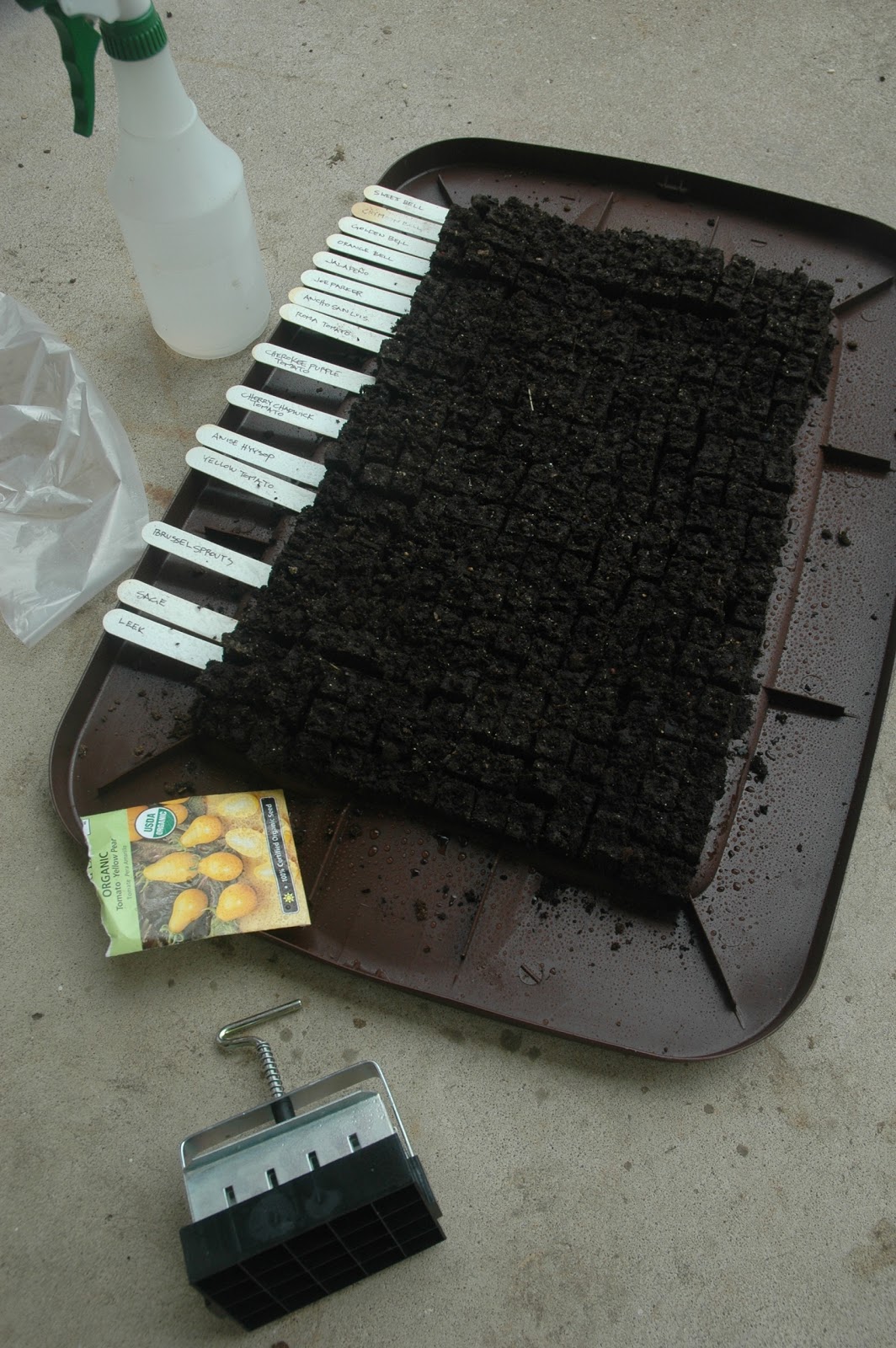
To the peat, I added 1 to 3 parts composted rabbit manure from my backyard warren, a handful of greensand, limestone dust, and. rock phosphorus. I now have enough for a batch of seeds, a few more batches later and maybe for the 2" cubes that I will transplant these 3/4" cubes into with their specially made dimples. I love the engineering mind that went into this system.
360 cubes fit on one tray. I would love to have one of those mesh plant trays for good drainage, but I will wait until one finds its way to me. Until then, a storage bin lid with a plastic bag over it will work as a humid environment for germination. I do have a plant heating pad that I sit on a towel for insulation.
Here is the list of veggies and herbs that go in this first batch 6 to 8 weeks before last frost:
Leek Varna (Peaceful Valley)
Anise Hyssop (Seeds of Change) statified in the freezer for one month.
Brussel Sprouts (Ferry Morse)
Sage (Peaceful Valley)
Tomato Yellow Pear (Organic Burpee)
Tomato Cherry Chadwick (Peaceful Valley)
Tomato Cherokee Purple (Peaceful Valley)
Tomato Roma Pompeii (Renee's Garden)
Tomato Mexican Heirloom (bought a Whole Foods Tomato)
Pepper Jalapeno (Renee's Garden)
Pepper New Mexico Joe Parker (Renee's Garden)
Pepper Ancho San Luis (Renee's Garden)
Bell Pepper Crimson, Gold and Orange (Renee's Garden)
Bell Pepper Carnival Mix (Organic Burpee)
Tuesday, February 15, 2011
Of igloos and rosemary
I spent the better part of this morning in an igloo. The snow has long since melted here, but my daughter still has her "igloo" tent up in the parlor room. She has it stuffed full of animals and books and loves to have me sit in the bean bag chair inside while showing me all her stuff. That would be more entertaining if I were not over 6 feet tall and the igloo was under 3 foot tall. Or maybe that image is exactly the entertaining part. I watched her closely while Mommy is running errands. The last time Mommy went out, she bought back two little rosemary plants on sale at the grocery store. They weren't in bad shape, so I planted them on either side of what will be out picket fence gate. I figured it is just as good as any time to plant herbs. They obstensively say "Rosemary Hardy" and are labeled Rosemarious Officianalis, which I take to mean that they do not know what variety they are. Should I really plant herbs outside in February? Just go for it, I tell myself. That's me saying to the heavens that we do not need another winter storm this year!!! Just in case, I have some milk jugs handy with their bottoms cut out to be little versions of daughter's igloo. Actually, I have dozens of them handy as I get ready for early spring planting. Weather in the central valleys of Arkansas have been so unpredictable that I dread a surprise heavy visit from Jack Frost.
Igloos inside and igloos outside at the ready. Spring cometh soon enough.
Igloos inside and igloos outside at the ready. Spring cometh soon enough.
Tuesday, February 8, 2011
Redirected energies.
We have had the most snow now for many seasons, and it's about to dump a record amount tomorrow. I guess I'll trust the weatherman enough this time to set my schedule aside for a snow day. Glorious white landscapes remind me of blank paper. Maybe it will give me time to express our little homestead's fate and write a bit. Yes, it's been a long time since posts. The land is pristine and practically untouched, while we have been working hard to prepare. Ok, no, that's not entirely true... we have setup a table and two chairs in the middle of the forest. They look insignificant. The enormity of the task ahead has daunted me.
The truth is we have bought a little house in the city of Little Rock instead and started our garden there. Our energies have been redirected to build my construction and architecture business, to gather our strength, and to focus on ourselves. Our goals are the same. It has taken me this long to realize that our efforts on this urban lot has still been part and parcel of our homesteading effort and worthy for mention in this blog. That silly little movie of Pixar's called "Up" may have helped me see this. The main character realizes his greatest adventure is and always will be dreaming with his wife and being with her. The grand adventurer is not the one who goes to the ends of the earth, but the one who sees the people around him and spends time with them, supports them, and laughs with them. In the same token, my devotion to wife and daughter drives me to make home where the hearth is.
Our efforts for our family to be strong, our environment to be cleaner and our food to be nutritious is the core of our homesteading efforts, and as such belongs in this blog. Maybe I can write now of our urban remodeling and gardening. Christi has made huge strides in protecting us from our toxic world and taking us into a new awareness of nutrition. My green business has taken off and we plan continuously of stepping onto the 60 acres with more knowledge and planning than ever before.
So, the blog shall continue with new emphasis. Our Griffin House Farm is on 6000 sq ft presently. The seeds are ready to start and so am I.
The truth is we have bought a little house in the city of Little Rock instead and started our garden there. Our energies have been redirected to build my construction and architecture business, to gather our strength, and to focus on ourselves. Our goals are the same. It has taken me this long to realize that our efforts on this urban lot has still been part and parcel of our homesteading effort and worthy for mention in this blog. That silly little movie of Pixar's called "Up" may have helped me see this. The main character realizes his greatest adventure is and always will be dreaming with his wife and being with her. The grand adventurer is not the one who goes to the ends of the earth, but the one who sees the people around him and spends time with them, supports them, and laughs with them. In the same token, my devotion to wife and daughter drives me to make home where the hearth is.
Our efforts for our family to be strong, our environment to be cleaner and our food to be nutritious is the core of our homesteading efforts, and as such belongs in this blog. Maybe I can write now of our urban remodeling and gardening. Christi has made huge strides in protecting us from our toxic world and taking us into a new awareness of nutrition. My green business has taken off and we plan continuously of stepping onto the 60 acres with more knowledge and planning than ever before.
So, the blog shall continue with new emphasis. Our Griffin House Farm is on 6000 sq ft presently. The seeds are ready to start and so am I.
Subscribe to:
Posts (Atom)


 Posts
Posts

